[ad_1]
Spain has 275,963 active registered doctors, according to the record of General Council of Official Colleges of Physicians (CGCOM), with a rate of 568 professionals per 100,00 inhabitants, but 24.9 percent will retire in the next decade, which represents nearly 69,000 retirements.
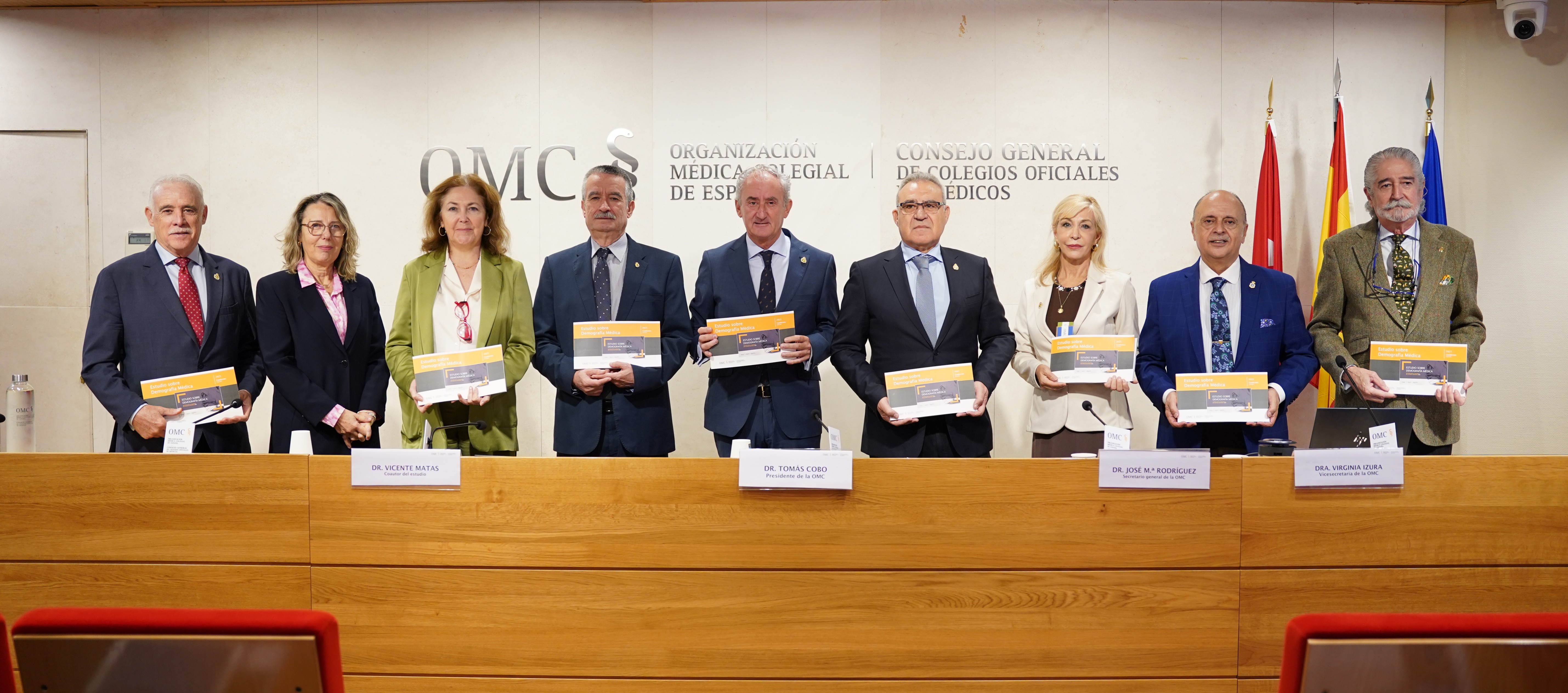
🩺🥼The Collegiate Medical Organization (OMC) presents the 2025 Medical Demographic Study
Proposes measures to guarantee generational change and the efficiency of the health system
Participate:
President of the WTO, @TomasCoboCastro
General Secretary, José M.ª Rodríguez… pic.twitter.com/HXmCHek4Ra— Collegiate Medical Organization of Spain (@OMC_Esp) October 30, 2025
“The message would be that in Spain there is no shortage of doctors (…) What we do need is better distribution and a better attraction so that we attract talent and remain within the National Health System (SNS),” the president of the Collegiate Medical Organization said this Thursday, Tomas Cobo, in the presentation of ‘Medical Demographics Study 2025‘, a 170-page report that offers a descriptive and prospective analysis of the current situation, historical and comparative European evolution of the medical population in Spain based on the information available in the CGCOM files, with data updated to 2025.
The report states that Spain exceeds the European average for medical density, according to Eurostat data in 2023, which shows that the country has 439 doctors per 100,000 inhabitants, compared to the European average of 420. This places Spain in the 11th place in the European Union (EU).
The Collegiate Medical Organization concludes in its study a series of proposals aimed at improving human resource planning and the sustainability of the health system once the data from the Medical Demography Study has been extracted and presented.
Among the main measures, the WTO proposes:
- The creation of a “replacement pact” in the Interterritorial Council that allows the replacement of health professionals to be coordinated between autonomous communities, especially in areas with the greatest deficit. This agreement would include mechanisms for the equitable redistribution of places, common planning criteria, incentives for mobility between territories and joint evaluation tools. Furthermore, the report warns that labor improvements linked to conciliation – such as maternity and paternity – will require an increase in staff to maintain quality of care.
- Given the lack of doctors in some specialties, they demand that policies be designed to encourage the permanence of professionals in the public system, including economic and tax bonuses for extension of work activity beyond retirement age.
- Likewise, the organization proposes a dynamic adjustment of MIR supplyadapting it to the retirement projections by specialty and territory, the emerging healthcare needs and the teaching capacity of the centers, with special attention to the hospitals and health areas of “emptied Spain”.
- The study also highlights the need for promote the use of new technologies and artificial intelligence (AI) as key tools to address the shortage of professionals. Among the measures, the promotion of telemedicine, the incorporation of diagnostic support systems based on AI, the digital training of professionals and the technological integration between Primary and Hospital Care stand out.
- Another of the measures that have been exposed in the presentation of the data has been the need to bet on promote professional development and female leadershippromoting transparent career plans, mentoring and management training programs, as well as active equality policies and visibility of female talent in Medicine and science. With these proposals, the medical corporation reaffirms its commitment to collaborating with the Administration to achieve more efficient, equitable health planning adapted to the demographic and technological challenges of the future.
For all these reasons, the WTO insists that medium and long-term planning is necessary and urgent for the needs of new specialists, graduates of the faculties and specialists who finish their training, for professionals whose training takes 11 or 12 years.
Study Highlights
- Currently the registry of the General Council of Official Medical Colleges (CGCOM) counts 275,963 active registered doctors.
-
Spain exceeds the European average for medical density. According to Eurostat (2023), Spain has 439 doctors per 100,000 inhabitants, compared to the European average of 420, ranking 11th in the EU.
- There is a unequal territorial distribution. Eight autonomous communities exceed the national average of 568 active doctors per 100,000 inhabitants (Madrid, Asturias, Navarra, Aragon, the Basque Country, Cantabria, Castilla y León and Extremadura), while Andalusia, Castilla-La Mancha, Ceuta and Melilla are below.
-
Catalonia, Madrid, Andalusia and Valencian Community They make up 59.7% of the country’s registered doctors. The provinces with the highest density are Madrid, Barcelona, Bizkaia and Gipuzkoa, and those with the lowest number of doctors per area are Zamora, Huesca, Soria, Cuenca and Teruel.
-
Growing feminization of the profession. Women represent 59.3% of active members, a trend that will continue to increase in the coming years. In faculties, seven out of ten medical students (71%) are women, which anticipates a structural change in the practice and organization of the profession.
-
Middle age and generational change. The average age of registered doctors is 47.5 years. Aragón, Asturias and Castilla y León present the greatest aging (more than 41% of their membership). On the contrary, the Valencian Community, the Canary Islands, Murcia and Madrid have the youngest cohorts.
-
Spain, world leader in number of medical schools. The number of faculties has increased from 44 to 53 (38 public and 15 private), which makes Spain the country with the most medical faculties per inhabitant in the world. University places in Medicine in private universities increased by 258% compared to 51% in public universities. Despite the growth, Spain remains below the OECD average in graduates: 13.6 per 100,000 inhabitants compared to 14.5.
-
Increase in MIR places. The offer of specialized training continues to rise: 12,366 places planned for 2026, of which 9,276 are in Medicine (3% more than in 2025). Family and Community Medicine concentrates the largest number, with 2,508 places.
-
Professional mobility. Since 1997, one in five doctors (17.9%) has changed provinces to practice. The greatest mobility is concentrated between 35 and 54 years of age. The Balearic Islands are the community that welcomes the most doctors, while Lleida and Tarragona are the ones that have seen the most professionals emigrate to other provinces.
-
Retirements and replacement. It is estimated that 69,000 doctors will retire between 2025 and 2035, which is equivalent to 24.9% of the current membership. The most affected specialties will be Legal and Forensic Medicine, Occupational Medicine, Clinical Biochemistry and Clinical Analysis. Only Asturias will not reach a replacement rate of 1, while Aragón will register the highest (2.32).
-
High presence of specialists. The national average is 2.15 specialists per 1,000 inhabitants, with Asturias (2.76), Navarra (2.65) and the Basque Country (2.53) leading the way. Eleven communities exceed the national average.
-
Family and Community Medicine, European strength. Spain ranks fourth in the EU with 94.8 specialists per 100,000 inhabitants, well above the European average (72.9).
- Expanding private healthcare. Since 2018, premiums in the sector have grown by 6.4%, reaching €34 billion, which represents 28.4% of total healthcare spending.
[ad_2]
Source link