
[ad_1]
The incidence of depressionone of the most common mental disorders, increased by nearly 50% between 1990 and 2017, according to data from the World Health Organization (WHO), and affects around 5% of the world’s population. In Catalonia, the number of people with this diagnosis has also increased significantly in recent years: Between 2017 and 2022, the incidence of depression and mood disorders grew by 86.6%according to data from the primary care of the public health system of Catalonia.
It has been shown that the use of new technologies in the treatment of this disorder, mainly through mobile applications, combined with face-to-face psychological interventions, can have significant effectiveness, while relieving health systems of the high care burden they experience.. The challenge is the quality of these mobile applications, which in most cases are not based on scientific evidence nor do they guarantee effectiveness when treating patients.
A team from the eHealth Lab research group of the Open University of Catalonia (UOC) has prepared a study to identify the most relevant criteria for patients when using applications for the treatment of depression. The final objective of this research is to develop a digital solution, which will be called EvalDepAppsto evaluate applications for monitoring this health problem and thus help affected people and health professionals when selecting the most appropriate ones to support them in their treatment. The study Validation and selection of criteria for evaluating apps for managing depression: a Delphi study has been published in British Medical Journal and has received funding from the State R&D&i Plan.
“In the same way that a medicine or medical device is evaluated before it reaches the market to ensure its effectiveness and safety, The mobile applications that we use to take care of our health and well-being should also be evaluated to know what effect they may have.something that is currently not done enough. They are applications that have a potential impact on the health of the population and that, in some cases, can even be harmful,” explains Carme Carrion, project leader and principal researcher at the UOC eHealth Lab.
The project EvalDepApps aims to develop a tool for the validation and evaluation of applications to treat depression based on scientific evidence and that responds to the needs of the patients who use them. This tool, which will also be a mobile application, will give clear instructions to users on how to choose an application for the treatment of depression that fits your needs and tastes.
Efficiency, safety and ease of use, the most relevant criteria
Within the framework of this project, the research team carried out a mapping of mobile applications that address depression and analyzed about thirty, of which only eight were based on published scientific evidence. To collect the most relevant criteria for users, 43 people were involved in a Delphi process, a prospective method to evaluate the importance that experts give to a topic.
The priority criteria valued by users when choosing an application were the data securitythe clinical efficacylet it be evidence based and, on the technical side, that it be intuitive and easy to use. It was also valued positively that the application allows interaction or urgent contact with mental health professionals or the health system, and that it is part of a therapeutic package, that is, it is not used in isolation and without the support of health professionals.
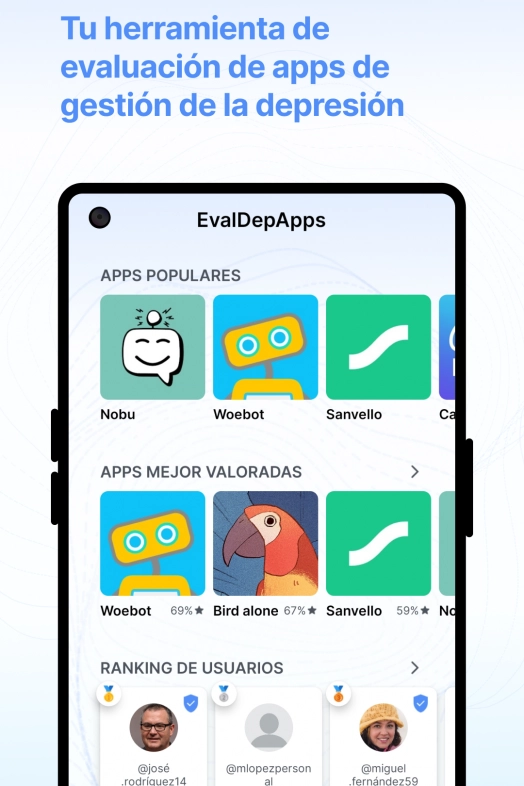
For Carrion, it is essential to establish what the priority function of the application is: “This point is key because, otherwise, we often tend to want to put too many things inside an application and then it becomes unusable. The saying ‘less is more’ here is very appropriate,” says the researcher. One of the most sensitive challenges posed by applications for the treatment of depression is privacy. This has been one of the aspects to which people with depression and health professionals who have participated in the study have given the most importance. “It is essential to keep in mind which group each application is aimed at, especially in terms of privacy,” says Carrion.
Another point that users highlighted is that the mobile application can measure the clinical evolution of the patient. Naomi Roblesmember of the Research Methods & Data Science Lab and researcher of the EvalDepApps project, explains that this particularity “can help the person to be more aware of their own emotional state and to do more personalized monitoring, if this information is shared with the professionals who care for them. It could be very valuable information, especially if the applications “have the ability to detect changes in mood or risk situations, so that extra support could be offered to the user.”
Another relevant aspect that emerged during the study was the fact that that the mobile application considers the gender perspective in the treatment of depression, given that men and women usually present different symptoms. For example, women show more feelings of sadness and guilt, while in men depression is expressed with greater irritability.
People, protagonists in the design of applications
One of the points highlighted by the eHealth Lab research team is the leading role that end users must play in the development of applications, from the beginning to the end of the creation process: “We must learn to take into account the opinions of users and understand that the process is not over until the users validate the application. Sometimes, despite co-creation, What seems valid on paper does not work in practice.. Therefore, it is important for the development team to keep in mind that there may be changes after the first test,” explains Carme Carrion, who is also a professor at the UOC’s Health Sciences Studies.
The next step of the EvalDepApps project is to recruit participants to make a pilot test in which users will be able to test this tool. Once validated, people with depression will have a mobile application that will guide them in selecting technological support to accompany them within the framework of the depression therapeutic plan. Although the tool is not intended for developers, the researchers explain that it can also be useful to know which are the most relevant aspects that people take into account and incorporate them into the design of the application.
The UOC eHealth Centre, recognized in digital health research on an international scale, is currently working on other projects within the field of health and new technologies, such as improving digital skills for oncology professionals; the development of a digital intervention for people who have had breast cancer; the design of a digital intervention for women in the premenopause stage, and the evaluation of a WHO mobile application that includes artificial intelligence to improve the training of primary care professionals in the diagnosis of skin diseases, among others.
[ad_2]
Source link