[ad_1]
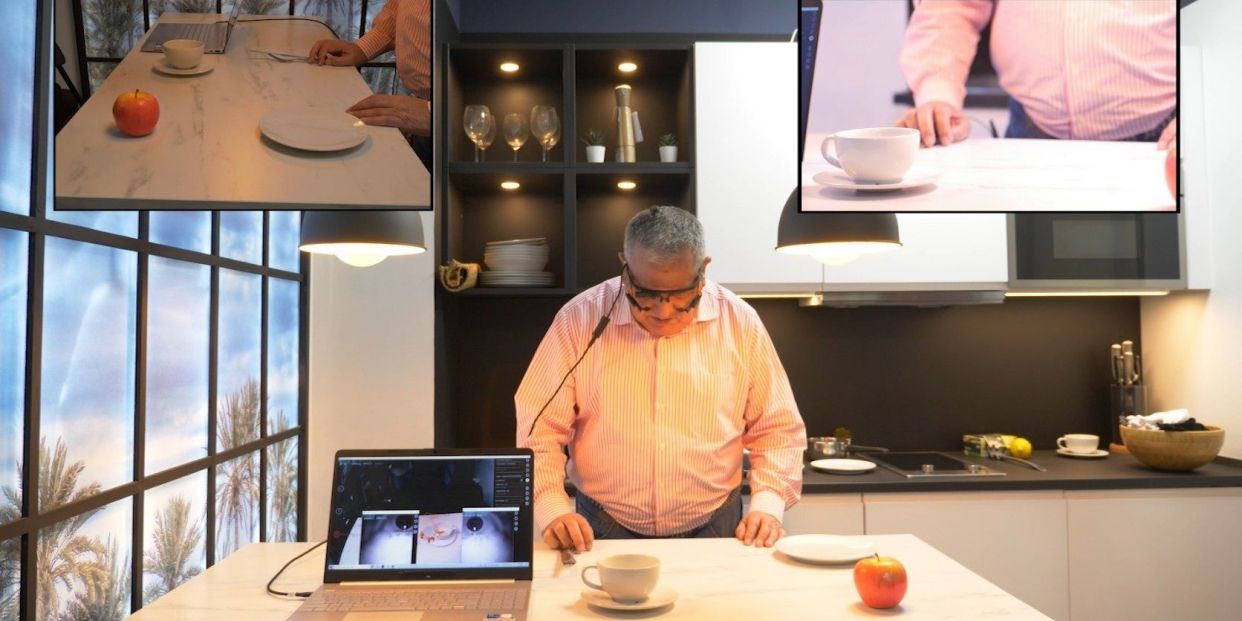
A patient with total blindness caused by irreversible damage to the optic nerve, has partially recovered natural vision after participating in a clinical trial of electrical stimulation of the visual cortex carried out by researchers from the Miguel Hernández University of Elche (UMH) and the consortium CIBER in Bioengineering, Biomaterials and Nanomedicine (CIBER-BBN).
The case, observed within the framework of a study designed to evaluate the safety and feasibility of a cortical visual prosthesis, has surprised researchers by showing a spontaneous visual improvement, sustained over time and independent of the implant, according to the academic institution in a statement.
The UMH Biomedical Neuroengineering Laboratory has carried out four clinical trials to date with blind volunteers. In this context, scientists have identified a phenomenon “as exceptional as it was unexpected”, since one of the participants, who had lived with total darkness for more than three years, began to gradually recover part of your vision natural after starting the direct electrical stimulation of your cerebral cortex.
“As in all trials, the objective was to generate artificial visual perceptions through direct stimulation of the brain, not to restore natural vision,” explains the principal investigator of the study and director of the UMH Bioengineering Institute, Eduardo Fernández Jover.
The fact that one of the participants experienced a measurable and sustained improvement in his vision suggests the possible influence of individual factors yet to be determined. The case has been published in the scientific journal ‘Brain Communications’.
“Very unusual”
The neurologist at the Hospital de la Vega Baja in Orihuela (Alicante) and member of the NBio group at the UMH, Arantxa Alfaro Sáez, points out that “although some cases of vision recovery have been described in patients with severe damage to the optic nerve, these have always occurred in the first months after the injury, so it is very unusual that it can occur after so long.”
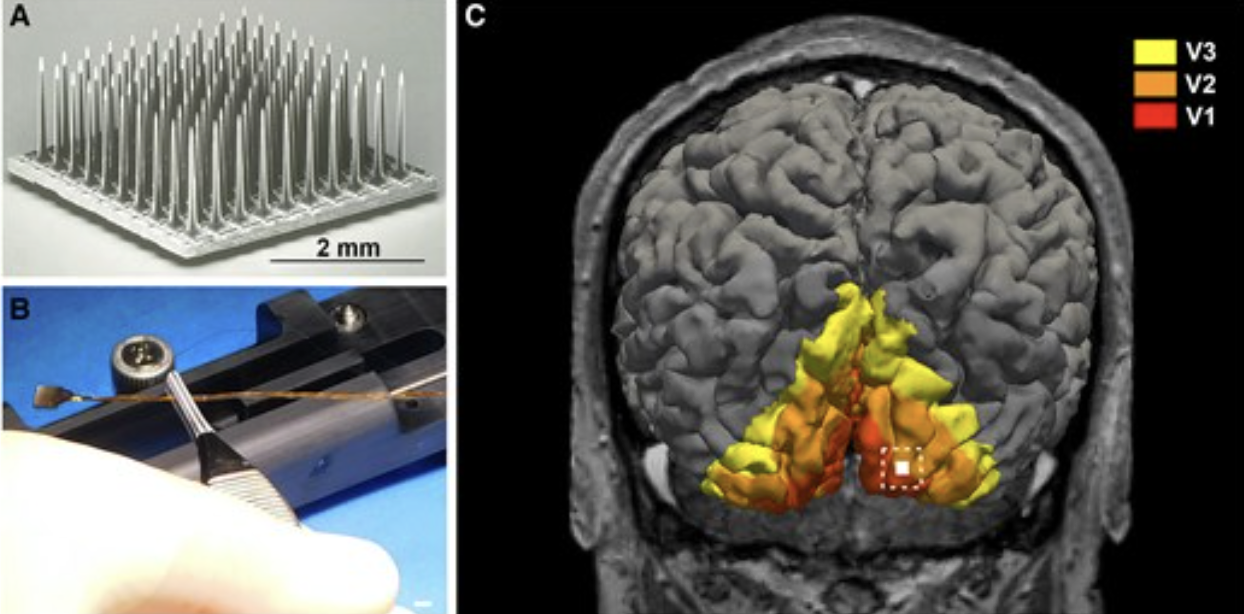
“The procedure consisted of surgical implantation of an intracortical array of one hundred microelectrodes in the primary visual cortex, the region of the brain responsible for processing visual information,” explains Alfaro.
Through this array, the researchers applied controlled electrical stimulation patterns to generate artificial visual percepts, known as phosphenes. Two days after surgery, while still hospitalized, the patient reported that he was beginning to perceive lights and movements in front of him.
“We had barely begun to stimulate his visual cortex to, let’s say, calibrate the system, but we started gesturing to him and the patient was able to correctly describe the position of our arms, he knew where the people around him were,” says Alfaro.
“A moving shadow”
According to the UMH, the patient described his first natural visual perception as “a moving shadow” years after becoming completely blind. Over the following months, the patient followed a daily vision training routine, with at least 30 minutes of standardized exercises.
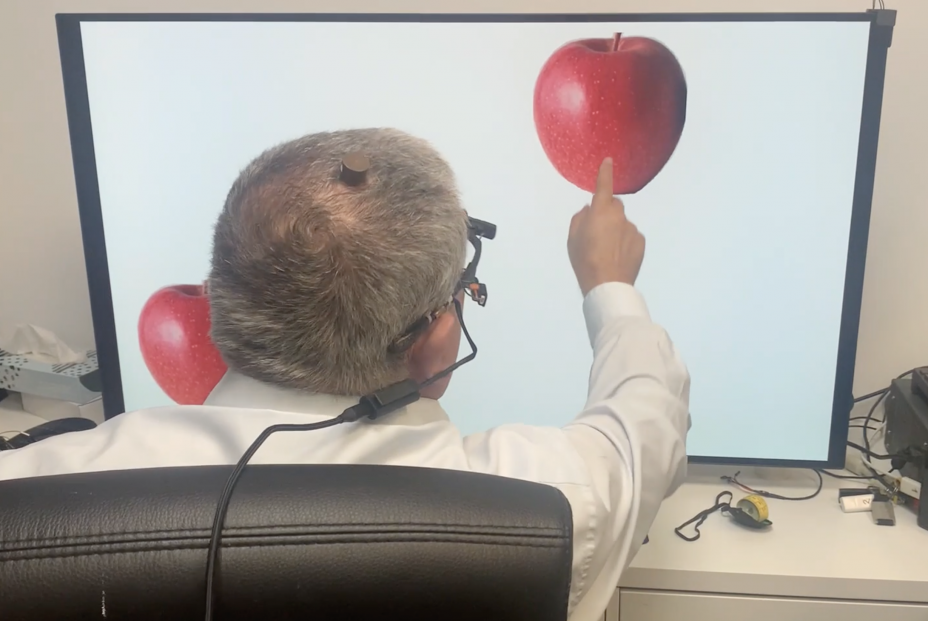
These tests included tasks of increasing complexity to assess light perception, spatial localization, movement, visual acuity, and contrast sensitivity, as well as search, identification, and tracking activities for objects, shapes, letters, and numbers.
The UMH researcher Leili Soo, also the first author of the study, states that this training, together with the motivation of the participant himself, could play a “relevant role” in the partial recovery of his natural vision. In fact, visual improvement persisted even after surgical removal of the intracortical implant.
“Visual evoked potentials, which are the electrical signals that the brain generates in response to visual stimuli and that tell us whether the information is arriving correctly from the retina, were practically absent in this participant before beginning the study,” emphasizes Soo.
However, these signs progressively reappeared and improved over time, confirming a real and measurable recovery. Overall, the volunteer showed a significant improvement in visual acuity and a notable increase in his autonomy and he was able to consistently identify shapes and letters, improve coordination when grasping objects and gain confidence in his everyday mobility. Likewise, the patient indicated that the recovered vision allowed him to function “with greater security” in his daily life.
“New therapeutic approaches”
According to the teacher Eduardo Fernandez, “These results could help develop new therapeutic approaches for the rehabilitation of visual function in people with severe lesions of the visual pathways, or even in other types of brain lesions, through non-invasive techniques such as transcranial electrical stimulation.”
In any case, he adds that the fact that these findings only occurred in one of the participants “suggests that there may be unique characteristics“in it” who have been able to contribute to these results.
However, the team emphasizes that “key aspects are still unknown”, among which are “how exactly the complex neural circuit that allows vision works, what are the optimal parameters to induce visual perceptions or how the brain responds to long-term artificial stimulation.”
“In addition, each brain is different and The response can vary greatly depending on the pathology, the duration of blindness and previous residual vision,” explains Fernández Jover, who warns that “the observed recovery may not be repeated in other patients.”
Future studies
Thus, future studies will determine if it is a isolated case or a reproducible phenomenon. “Precisely because of this diversity, we are enormously grateful to this patient and to all the people who have participated in these clinical trials,” say the UMH researchers.
“None has done so with the expectation of seeing again, but with the awareness that their contribution helps advance knowledge about how to restore the complex neural dialogue that makes vision possible,” they point out.
The clinical study that has given rise to these results has been carried out in close collaboration with the IMED Elche Hospital. In 2021, the UMH Biomedical Neuroengineering laboratory managed to safely implant a device in the brain of a blind person capable of inducing the perception of shapes and letters with a much higher resolution than had been achieved to that date.
The group has also developed technology that is capable of establishing a bidirectional communication with the visual cortex to achieve more natural and functional artificial vision. Thanks to this, implanted people have been able to recognize objects and letters, and even move and orient themselves in complex environments.
Dorota Waclawczyk, Roberto Morollón and Fabrizio Grani, researchers at the UMH Bioengineering Institute and the Bidons Egara Chair, also signed the study. Alfaro and Fernández Jover are also part of the CIBER-BBN consortium, attached to the Carlos III Health Institute.
The study has had funding from the Ministry of Science, Innovation and Universities; the European Union (EU), through the Horizon 2020 program, and the program for research groups of excellence of the Generalitat Valenciana.
[ad_2]
Source link