[ad_1]
A team led by the CSIC Barcelona Microelectronics Institute (IMB-CNM-CSIC) It has presented a new diagnostic platform for the detection of viral RNA sequences that allows to shorten the detection process by not requiring previous stages of sample treatment, such as the genetic amplification that is done in the current molecular diagnoses.
Researchers point out that their ability to detect the virus directly in clinical samples is a significant change to combine “Speed, versatility and low cost”. The instrument, whose results have been published recently in Analytical Chemistryis designed to diagnose viral infections in nasopharyngeal samples.
Although so far its viability has been demonstrated in the detection of the SARS-COV-2 virus, the researchers highlight that the New Test versatility allows it to be adapted to identify other infectious diseases.
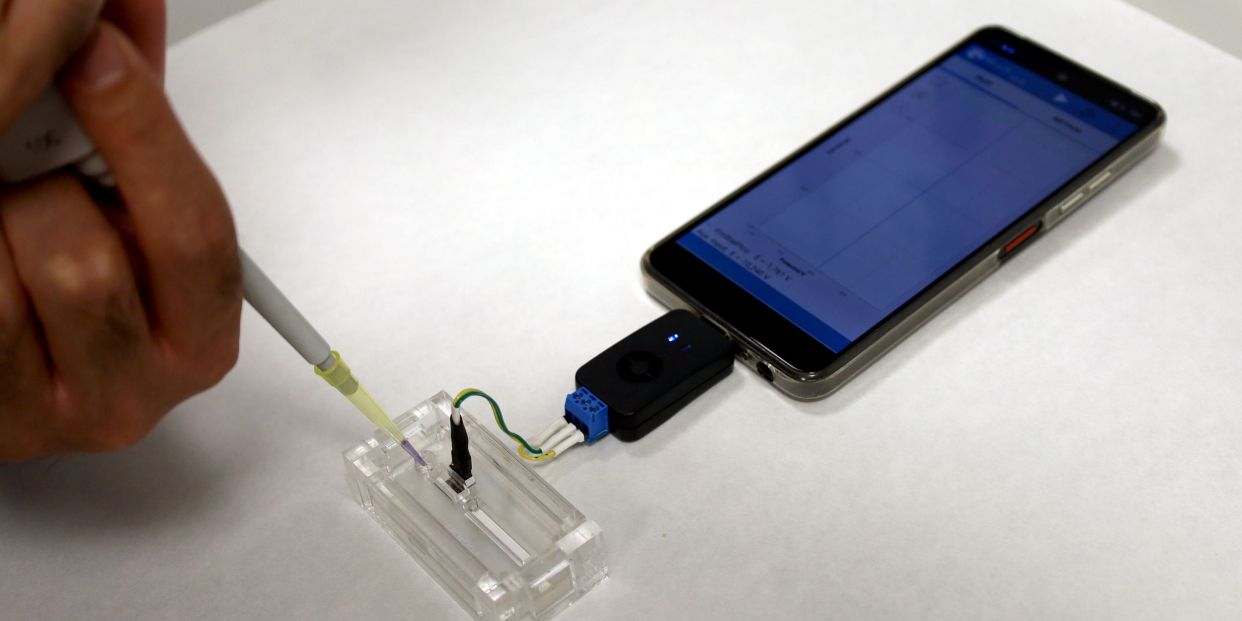
“The device includes microfluidic paper, electrochemical measure, using miniaturized electrochemical cell produced in a silicon chip, and the use of functionalized magnetic nanoparticles complementary to the sequences of the viral RNA, selected as biomarkers, allowing the detection in a maximum time of 40 minutes,” he said César Fernándezprincipal project researcher in the Group of Chemical Transducers of the IMB-CNM-CSIC.
Besides, Fernández He stressed that its “innovative” development contributes to the device “portability and simplicity, resulting in an estimated price for lower than 1 euro.”
This time savings is relevant compared to the more than 24 hours that can happen between sample and obtaining PCR results. The analytical standard for the detection of COVID-19 during the pandemic was based on the polymerase chain reaction (PCR), which implied the transport of samples to the laboratory after extraction.

Now, the instrument developed by the IMB-CNM seeks to improve this molecular diagnosis, bringing it to the patient’s point. “It is a very simple, cheap and low consumption electrochemical device,” he adds Fernández.
The system has demonstrated a sensitivity of 100% and a specificity of 93 percent, a percentage that refers to the test capacity to correctly identify people who have no infection, thus avoiding “false positives.” These figures have been proven in the detection of the SARS-COV-2 RNA, demonstrating the great potential it presents as a molecular diagnostic tool.
“It is a very versatile tool that could easily adapt to detect other infectious diseases that require the rapid and efficient implementation of mass screening programs. If, in addition, we take into account its low cost, the platform could be used in low -income countries,” he explains Manuel Gutiérrez-CapitánResearcher at the IMB-CNM-CSIC, who added that “it is an advance by not requiring previous stages of treatment and being able to apply at the point of necessity by non-specialized personnel.”
The device is made up of three components: a silicon chip that contains an electrochemical cell formed by two gold electrodes, manufactured with microelectronics technology; A fluid paper component, and a methacrylate housing to align and contact electrochemical cell (chip) and paper. The only disposable and interchangeable component is paper, which can be recycled normally.
In addition, the device Use nanoparticles Magnetic functionalized, that is, intentionally modified to provide them with new capacities, by using oligonucleotide strands (synthetic DNA or RNA molecules) complementary to the sequences of the viral RNA. These allow separating the biomarker of interest from the sample matrix and, in turn, preconcentrating it in the ideal environment for analysis.
Currently, a pre -industrial prototype is being validated that integrates the measuring electronics fed with the battery of a mobile device, along with a app of control. This way, A completely autonomous device would be achievedinterconnected and portable.
The device is the result of a work that began in full emergency of the Covid-19 pandemic in 2020, in collaboration with several groups of the Advanced Chemistry Institute of Catalonia (IQAC-CSIC), the University of Barcelona, the Severo Ochoa Molecular Biology Center (CBMSO-CSIC) and the University Hospital Germans Trias I Pujol de Badalona. It has been funded with CSIC own funds, through donations, and with recovery funds obtained by the Interdisciplinary Thematic Platform (PTI) Global Health of the CSIC.
[ad_2]
Source link