[ad_1]
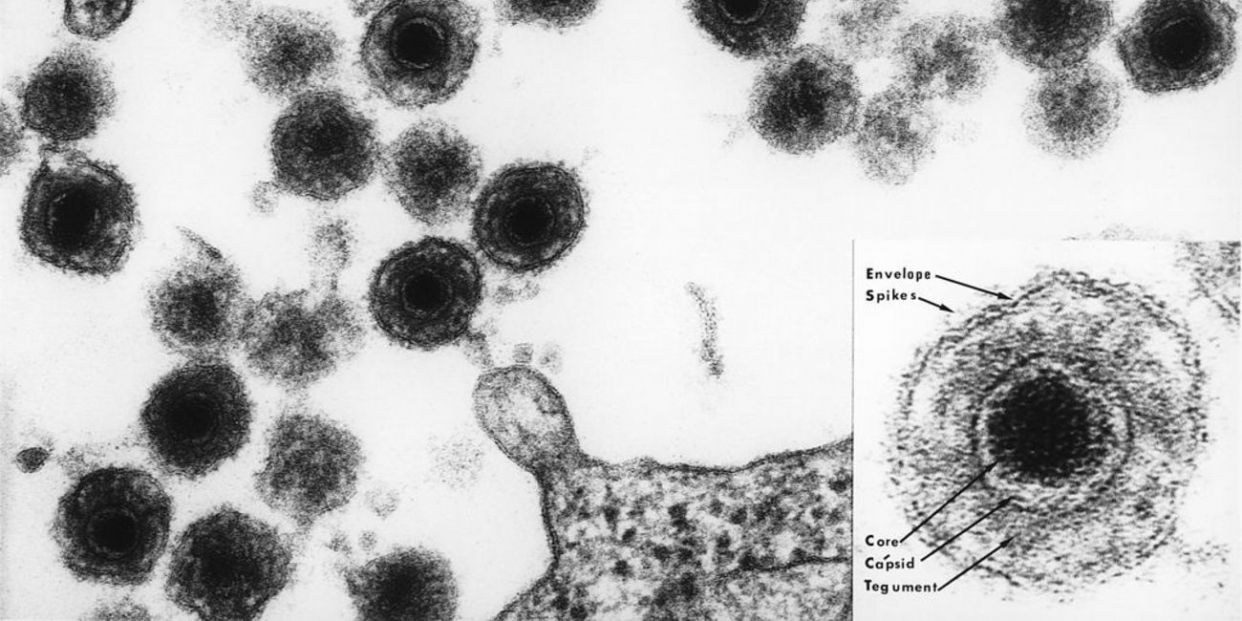
A team of European scientists has managed to reconstruct, for the first time, ancient genomes of human betaherpesvirus 6 (HHV-6)a very common pathogen today, from human remains up to 2,500 years old. The work, led by the University of Vienna and the University of Tartuand published in Science Advancesdemonstrates that these viruses have accompanied human beings since at least the Iron Age.
HHV-6B infects approximately 90% of children before the age of two. It is the cause of the infantile roseolaknown as the sixth disease, and is behind many febrile seizures in early childhood. Its “cousin”, HHV-6A, is less known, but both are part of a large family of herpesviruses that usually stay with us for life after a mild infection.
What makes these two viruses special is that can integrate into human chromosomes. In this way, the virus remains latent and, in exceptional cases, it can be inherited from parents to children as if it were just another gene. Today, around 1% of the world population carries these inherited viral copies. Until now, it was suspected that these integrations were very old, but direct proof was lacking, which has been provided by this study.

Tracking viruses in European skeletons
To find it, the researchers analyzed almost 4,000 human skeletons coming from archaeological sites throughout Europe. They managed to identify and reconstruct eleven ancient viral genomesthe oldest belonging to a girl from the Iron Age in Italy (1100-600 BC).
From there, the map expands: Medieval England, Belgium, Estonia, Italy, and early medieval Russia. In some places, such as the Belgian site of Sint-Truidenboth types of viruses circulated within the same population. Several English individuals carried inherited forms of HHV-6B, making them the first known carriers of human herpesviruses integrated into chromosomes.
“While HHV-6 infects almost 90% of the population at some point in their lives, only about 1% carry the virusinherited from their parents, in all the cells of their body,” explains Meriam Guellil, principal investigator of the study. “This 1% of cases is the one that we are most likely to identify using ancient DNA, which makes the search considerably difficult.” According to her, the data allow us to follow the evolution of the virus during more than 2,500 yearsfrom the 8th-6th centuries BC. C. until today.

A virus that is inherited
The analysis of these ancient genomes allowed us to find out at what points on the human chromosomes the viruses were integrated. When compared with modern data, scientists found that some of these integrations occurred a long time ago and have been passed down from generation to generation for millennia.
Furthermore, the study reveals that both viruses did not follow the same evolutionary path. He HHV-6A appears to have lost its ability to integrate into human DNA over timewhile the HHV-6B maintained it.
This detail is not just a historical curiosity. “The presence of one copy of the HHV6B virus in the genome has been linked to the angina pectoris and the heart disease” says Charlotte Houldcroft, a geneticist at the University of Cambridge. “We know that these inherited forms of the virus are most common in the UK today than in the rest of Europe, and this is the first evidence of ancient carriers from Britain.”
An ancient relationship between viruses and humans
Beyond the specific case of HHV-6, the discovery opens a window to the coevolution between humans and pathogens. It demonstrates that some infections not only accompany us throughout life, but can leave lasting traces in our own genome.
Discovered scientifically in the 1980s, the HHV-6A and 6B viruses now have a documented past dating back to the Iron Age. As the authors conclude, modern genetic data already suggested that these viruses could have evolved alongside humans since their departure from Africa. Ancient genomes finally provide concrete proof of that long coexistence.
[ad_2]
Source link