[ad_1]
The atrial fibrillationthe most common cardiac arrhythmia, is especially difficult to treat when it becomes persistent. In these advanced stages, the heart rarely recovers its normal rhythm on its own. Now, a study led by the Carlos III National Cardiovascular Research Center (CNIC), and published in Circulation Researchhas revealed new cellular mechanisms that allow it to be maintained long-term, pointing to a key role for non-contractile cells in the heart.
Until now, research has focused almost exclusively on cardiomyocytesthe cells responsible for cardiac contraction. However, the CNIC team has shown that other heart cells, which do not contractplay a decisive role in maintaining the arrhythmia over time.
As explained David Filgueirashead of the Advanced Development group in Arrhythmia Mechanisms and Therapies at the CNIC, there are specific areas of the atria that act as true drivers of arrhythmia. “These areas, which we call driver or driving regionsthey present a faster electrical activity than the surrounding tissue and act as true motors that maintain atrial fibrillation over time,” he explains.
These regions are not the same in all patients. The study shows that each heart develops specific areas with its own cellular environment that favors the persistence of atrial fibrillation. They concentrate on them fibroblasts and macrophagescells that do not directly participate in the heartbeat, but that decisively influence the functioning of the tissue.
A microenvironment that protects cells
The researcher Ana Simonfirst author of the work, explains that these cells generate “a specialized cellular microenvironment that favors homeostasis and long-term cell survival, something crucial for maintaining atrial fibrillation.”
One of the most relevant findings is that the macrophages present in these areas do not have an aggressive inflammatory profile, as was thought. On the contrary, they predominate cardiac resident macrophagesassociated with protective functions, metabolic support and cell survival.
“This cellular combination could help cardiomyocytes tolerate the intense electrical and energy demand imposed by persistent atrial fibrillation,” adds Filgueiras.
A change of focus for the future
The study has not stayed in the laboratory. Researchers have combined experimental models very similar to the human heart with the analysis of cardiac tissue from patients with persistent atrial fibrillation. The mechanisms described also appear in real disease.
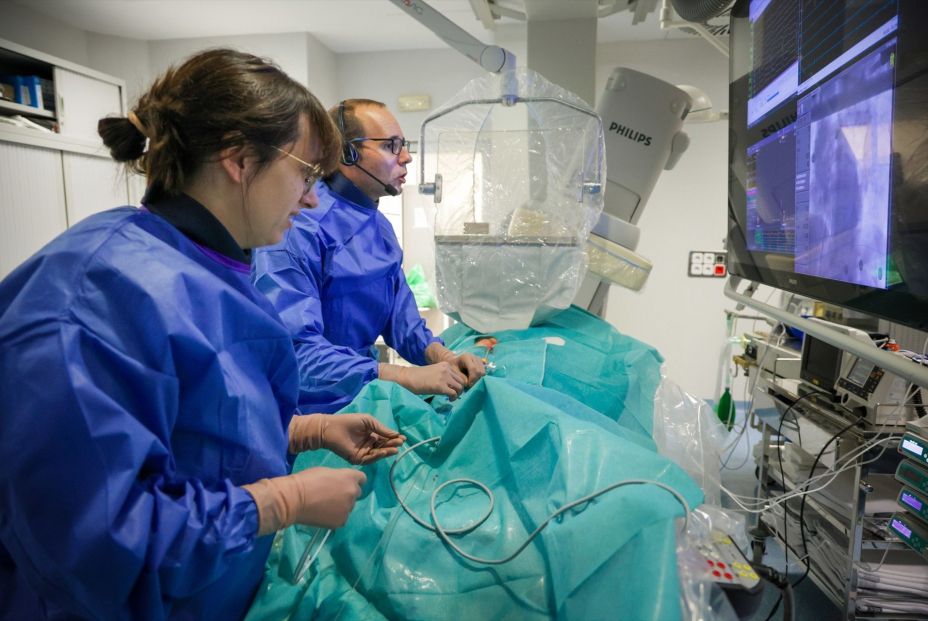
Furthermore, they verified that selective removal of these driver regions using ablation techniques – a medical procedure to destroy or remove tissue – was able to interrupt the arrhythmia in experimental models and was associated with better long-term rhythm control in patients.
The authors highlight that these findings dismantle the idea that the changes caused by arrhythmia affect the entire heart equally. Atrial remodeling, they explain, it is not uniformbut it depends on specific areas and the cellular profile of each patient.
This discovery opens the door to new therapeutic strategiesdirected not only at cardiomyocytes, but also at non-contractile cells and molecular mechanisms that allow the arrhythmia to become chronic.
[ad_2]
Source link