[ad_1]
A pilot project will test the use of exoskeletons in social health workers with the aim of preventing injuries in activities with high impact on lumbar and dorsal muscle ailments and injuries.
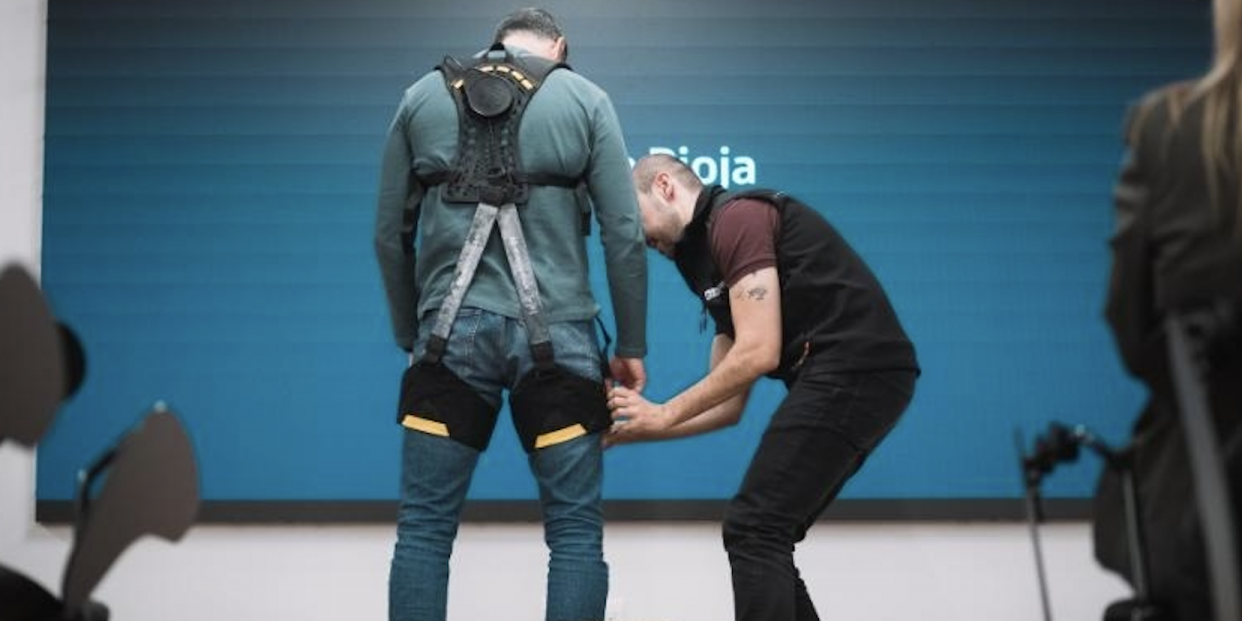
La Fombera has been the scene of an exhibition of the use of the four exoskeletons acquired by the Government of La Rioja and that will be used by workers of the Fuenmayor Care Center for People with Disabilitiesthe Residence of Los Manitos de Calahorra and the Saint Peter’s Hospital.
The objective is for these people, in a period that will last until the end of the year, to write down the results of their use. These are people without previous pathologies who are provided with a passive device, that is, it does not activate force but rather Provides the foundation for correct posture.
With them, it is achieved that the force when, for example, lifting a patient is carried to the glutes and quadriceps, saving the lumbar and, therefore, avoiding future injuries.
“What it will allow,” explained the Minister of Economy and Innovation, Belinda Leon, It is, in addition to the “satisfaction” of the worker, a “reduction in possible injuries.”
And, he said, 34 percent of work accidents, and more than 88 percent of pathologies, are centered in the lumbar area “due to those overexertions that are carried out daily in this social and health field” with “the difficulty they have.”
The Health Minister, Maria Martin, He explained that, in the case of nursing homes, it will be used by workers who have to make more effort moving already dependent elderly people and, in the case of the hospital, “those who have to make more effort when picking up sick people.”
Specifically, the General Directorate of Labor and Occupational Health has acquired four Herowear Apex Suit 2 modelsone of the “most advanced and scientifically validated passive lumbar exoskeletons, with special relevance for the prevention of musculoskeletal disorders in work environments,” the Executive has indicated.
It is a passive lumbar exosuit – without motors or batteries, its weight is around 1.4 kilograms – developed from biomechanical research begun at Vanderbilt University (Nashville, Tennessee) in 2015.
It was launched on the market in 2023 as an evolution of Apex 1 (2020), incorporating three years of real user feedback in sectors such as logistics, manufacturing, construction and agriculture. “It is backed by dozens of independent, scientifically reviewed studies,” he said.
Once the first three months of testing have been completed and with the project – which will end at the end of this year – still ongoing, data collection will begin to prepare a detailed analysis to evaluate its possible definitive implementation.
[ad_2]
Source link